
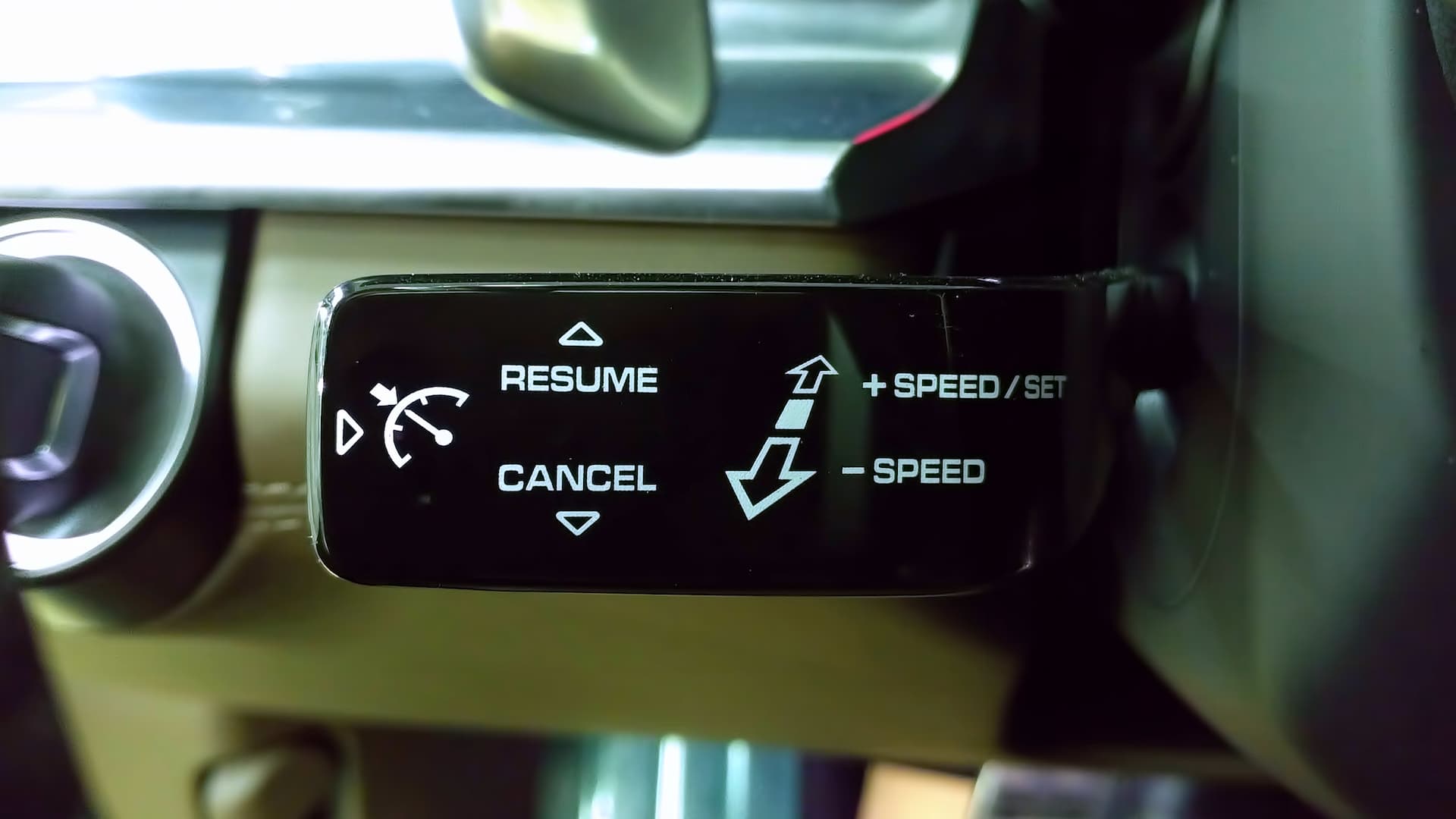
An adaptive cruise control (ACC) warning light can mean the system is turned on, temporarily unavailable, or experiencing a problem. The exact meaning depends on your vehicle, so the symbol’s color alone doesn’t always tell the whole story.
If your vehicle uses a yellow, amber, or red ACC light to indicate a fault, avoid relying on adaptive cruise control until you know what caused the warning.
Start with the basics:
- Check the radar and camera areas for dirt, ice, snow, or other obstructions.
- Restart the vehicle if everything looks clear.
- If the warning stays on or returns, the system may need diagnosis or calibration.
Keep reading to learn what can trigger an adaptive cruise control warning light and what to do next.
This Article Contains
- What Does the Adaptive Cruise Control Warning Light Mean?
- 6 Common Causes of an Adaptive Cruise Control Warning Light
- What Should You Do When the ACC Warning Light Comes On?
- Can You Drive With the Adaptive Cruise Control Warning Light On?
- How Much Does It Cost to Fix Adaptive Cruise Control?
- Adaptive Cruise Control Warning Light FAQs
What Does the Adaptive Cruise Control Warning Light Mean?
Adaptive cruise control (ACC) automatically adjusts your vehicle’s speed to help maintain a set distance from the car ahead. Depending on the vehicle, it may use a radar sensor, a forward-facing camera, or both.
Not every ACC dashboard light means something is wrong:
A. ACC Ready or Set
Some ACC symbols simply show that the system is:
- Switched on but not yet set
- Maintaining your selected speed
- Tracking a vehicle ahead
Some vehicles display separate ACC Ready and ACC Set indicators. Check the accompanying message and your owner’s manual rather than judging the symbol by its color alone.
B. ACC Unavailable or Fault
An ACC warning can also mean the system is temporarily unavailable or has detected a problem. You may see messages such as:
- ACC unavailable
- Adaptive cruise control fault
- Front radar blocked
- Clean sensor
- Driver assistance unavailable
The cause may be temporary, such as heavy rain or a dirty sensor. But persistent warnings can indicate calibration, electrical, or other system faults that require attention.
6 Common Causes of an Adaptive Cruise Control Warning Light
Here are some common reasons an ACC warning appears:
1. Blocked Radar Sensor or Camera
ACC needs a clear view of the road ahead. The radar and camera help the ACC system measure the relative speed and closing speed between your vehicle and traffic ahead so it can maintain a safe distance.
Depending on the vehicle, the radar sensor may sit behind the front emblem, grille, or bumper, while the camera is often mounted near the top of the windshield.
Mud, dirt, bugs, snow, ice, or other obstructions can interfere with the system.
2. Heavy Rain, Snow, Fog, or Poor Visibility
Bad weather and poor road conditions can make it harder for radar or cameras to accurately identify vehicles. Heavy rain, dense fog, snow, or ice buildup may cause ACC to switch itself off temporarily. Even after road conditions improve, the warning may remain briefly while the system checks its sensors.
If visibility improves and the warning clears, the system may not have a permanent fault.
3. Radar or Camera Misalignment
ACC sensors must be positioned accurately.
A minor impact, damaged mounting bracket, or changes around the bumper or windshield can knock a radar sensor or camera out of alignment. The vehicle may then disable ACC even if the sensor itself still works.
4. Recent Windshield, Bumper, Alignment, or Suspension Work
A windshield replacement can affect a camera mounted behind the glass, while bumper or grille repairs can disturb radar sensors. Alignment, suspension, or tire changes may also affect some driver-assistance systems.
On some cars, camera or radar calibration may be needed after this type of work. If the warning appeared after a windshield replacement, mention it to the technician. The ACC system may need ADAS calibration rather than a new sensor.
5. Electrical, Battery, Wiring, or Software Fault
ACC depends on several electronic systems working together. A weak battery, low voltage, damaged wiring, module communication problem, or software fault can cause ACC to shut down.
Consider this possibility if several warning lights appear at the same time.
6. A Related ADAS or Vehicle-System Fault
ACC may share sensors and data with systems such as:
- Forward collision warning
- Automatic emergency braking
- Distance warning
- ABS
- Traction control
- Electronic stability control
The same forward camera may also support systems that detect lane lines, so a single camera fault can trigger several warnings. For example, a fault may disable forward collision warning or automatic emergency braking, or trigger a separate distance warning while ACC is unavailable.
In any case, if the ACC light appears, there are a few things you can check before assuming the system needs repair.
What Should You Do When the ACC Warning Light Comes On?
Start with the basics before replacing sensors or other parts:
1. Read the Dashboard Message
Check any text displayed with the warning.
There’s a big difference between:
- ACC Ready
- ACC unavailable
- Sensor blocked
- ACC fault — service required
The message can tell you more than the symbol alone.
2. Clean the Radar and Camera Areas
Check the front grille, emblem, bumper, and windshield around the camera area. Carefully remove dirt, snow, ice, bugs, or other debris.
Because sensor locations vary, check your owner’s manual before touching anything around the system.
3. Restart the Vehicle
If the sensors are clear and conditions are normal, safely switch the vehicle off and restart it. This may clear a temporary ACC fault, but it won’t fix an underlying problem if the warning keeps returning.
4. Don’t Rely on ACC Until the Warning Clears
If ACC is unavailable, control your speed and following distance yourself. On the highway, that means manually maintaining your desired speed or cruising speed and using the brake when needed.
Remember that ACC has limits. Keep a safe distance from traffic ahead, and don’t assume the system will react to every hazard or changing speed limit. Those limits matter especially in heavy traffic, where you may need to control your desired speed and bring the vehicle to a complete stop yourself.
5. Get the System Diagnosed if the Warning Returns
Professional diagnosis is a good idea if:
- The warning stays on in clear weather
- Cleaning the sensor doesn’t help
- The warning keeps coming back
- Several driver-assistance warnings appear together
- The problem started after windshield, bumper, alignment, or suspension work
A technician can scan for fault codes and check whether the problem involves a sensor, calibration, wiring, software, or another vehicle system.
If the warning remains, the next question is whether the vehicle is still safe to drive.
Can You Drive With the Adaptive Cruise Control Warning Light On?
An ACC warning usually means you should stop relying on adaptive cruise control, not that the entire vehicle is unsafe to drive.
If the car still brakes, steers, and drives normally, you can generally continue driving manually while paying extra attention to your speed and following distance.
However, take other warnings seriously. If braking, ABS, steering, or stability-control warnings also appear — or your vehicle tells you to stop — follow your owner’s manual and arrange for service.
How Much Does It Cost to Fix Adaptive Cruise Control?
The cost depends on the cause. A blocked sensor may cost nothing to clean, while calibration, electrical repairs, or damaged ADAS components can cost much more. Some examples:
| ACC-related repair | Typical cost |
| Radar/camera calibration | Up to about $600 |
| Wheel speed sensor or tone-ring repair | About $180–$450 |
| Front radar sensor repair/replacement | About $500–$1,300 |
| Front camera sensor repair/replacement | About $600–$800 |
Because an ACC warning can also come from calibration, wiring, or another vehicle system, diagnose the fault before replacing expensive sensors.
Still have questions?
Adaptive Cruise Control Warning Light FAQs
Let’s address some common questions on ACC and its warning light:
Adaptive cruise control (ACC) maintains a set distance from the vehicle ahead. Unlike conventional cruise control, which holds a set speed, an adaptive cruise control system can slow down or accelerate as traffic conditions change.
Some automakers use terms such as ‘active cruise control’ or ‘intelligent cruise control’. More advanced ACC systems can even bring some cars to a complete stop in heavy traffic before moving again.
To understand how adaptive cruise control works, think of it as regular cruise control with extra sensing. The system compares your set speed with traffic ahead and adjusts speed to maintain the set distance.
Radar and cameras can monitor relative speed and closing speed, but the driver remains responsible for braking and overall safety. You may also hear ‘radar cruise control’ used for radar-based ACC, while some older systems used laser sensing.
Check the radar and camera areas for dirt, snow, ice, or other obstructions. If they’re clear, restart the vehicle. If the warning returns, the system may need to be diagnosed or calibrated.
If the symbol only shows that cruise control is switched on, turning the system off may remove it.
A genuine ACC fault is different. Clearing the warning without fixing the cause won’t repair the system.
Switching the vehicle off and restarting it may clear a temporary ACC fault. There’s no universal reset procedure, though. Check your owner’s manual before trying model-specific steps, and avoid disconnecting the battery or removing fuses just to clear the warning.
Get an ACC Warning Diagnosed
If your adaptive cruise control warning keeps returning after the sensors are cleaned and the vehicle has been restarted, it’s worth having the system diagnosed before replacing expensive parts.
AutoNation Mobile Service can bring expert car care to your location, with easy online booking and 7-day availability. Qualifying repairs are also backed by a 12-month/12,000-mile warranty, giving you added peace of mind after the job is done.