
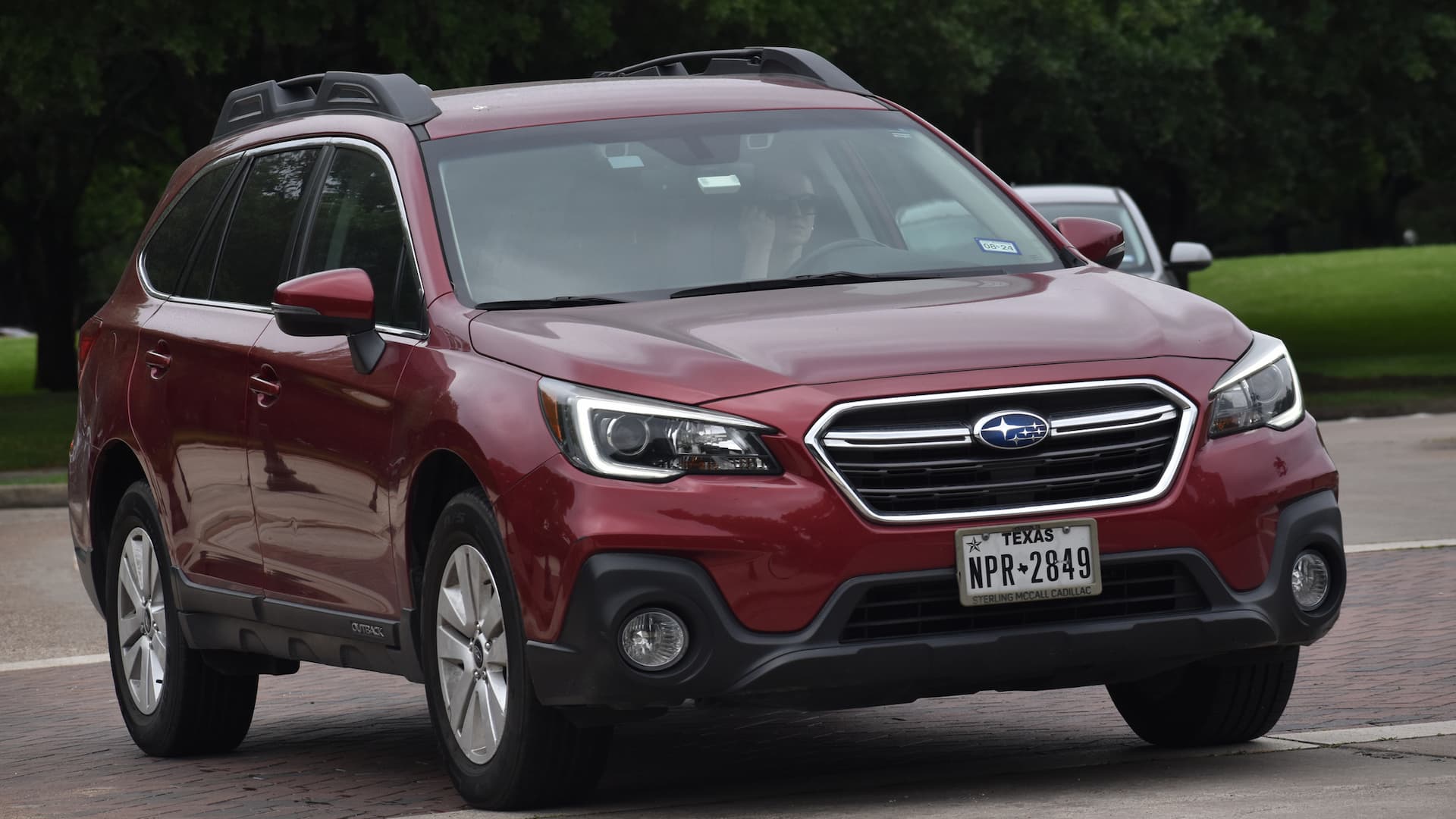
The Subaru Outback is a practical and dependable crossover with average maintenance costs, known for its standard All Wheel Drive (AWD) and versatile design.
Industry Rankings:
- The Outback earned a J.D. Power overall consumer rating of 83/100 in 2026.
- Edmunds gave it an overall reliability rating of 7.6/10 in 2026.
Strengths:
- Excellent All Wheel Drive design for strong traction.
- High ground clearance for both light off-roading and paved roads.
- Built-in roof rails and hitch option.
- Good fuel efficiency with strong actual mileage, supported by competitive Environmental Protection Agency (EPA) fuel economy ratings.
- Subaru Boxer engine (named for its horizontally opposed, symmetrically arranged pistons) pairs with AWD for improved stability.
- Spacious interiors for both passenger and cargo space.
- Large touchscreens with Android Auto and Apple CarPlay options.
- Advanced safety features like Eyesight driver-assist technology, adaptive cruise control, and blind spot monitoring.
- Earned the Top Safety Pick+ award from the Insurance Institute for Highway Safety (IIHS) in 2026.
Weaknesses:
- Windshield cracking issue
- Cooling system and overheating problems
- Transmission-related shudder during acceleration
- Sensor failures and high fuel consumption
- Frequent headlight burnout
- Airbag recalls
Best and Worst Model Years:
- Most reliable years include 2014, 2016, 2017, and 2021+.
- 2013, 2015, and 2018 are often reported as less reliable; 2005–2007 models had head gasket issues.
We’ll take a closer look at Subaru Outback reliability — its strengths, weaknesses, maintenance costs, best model years, and warranty coverage to help you make the right choice.
This Article Contains:
- What Industry Rankings and Reviews Say About Subaru Outback Reliability
- What Are the Ownership and Maintenance Costs of a Subaru Outback?
- What Are the Pros and Cons of Owning a Subaru Outback?
- What Are the Best and Worst Model Years for the Subaru Outback?
- How Long Does a Subaru Outback Last?
- How Do Old Subaru Outback Models Compare to New Ones
- 4 Smart Tips to Purchase Pre-Owned Subaru Outback Vehicles
- Subaru Outback vs. Competitor Ratings
- What Warranty and Coverage Options Come with a Subaru Model?
What Industry Rankings and Reviews Say About Subaru Outback Reliability
Here’s what industry experts and car owners say about a Subaru Outback’s dependability:
A. J.D. Power Consumer Rating, 2026
This reliability rating is based on feedback from actual vehicle owners, focusing on long-term dependability, build quality, and how the vehicle holds up over time.
Here’s what the Subaru Outback scores:
- Overall score: 83/100
- Quality and reliability: 81/100, considered “Great”
B. Edmunds, 2026
This is an expert-driven review that evaluates how the vehicle performs in everyday use, including comfort, features, and driving experience.
The ratings are as follows:
- Overall rating: 7.6/10
- Category highlights:
- Comfort: 8.7/10 (assesses ride quality, seating, cabin space, and noise levels)
- In-cabin tech: 9/10 (evaluates infotainment systems, connectivity features, and ease of use)
While the Outback’s reliability stats are useful, it’s the cost of maintaining this model that truly reflects its dependability.
What Are the Ownership and Maintenance Costs of a Subaru Outback?
Owners typically spend around $610 per year on repairs and maintenance for this model. This is slightly higher than the midsize SUV average ($570), but still lower than the overall average across all vehicles ($650). That’s why the Outback is seen as a cost-effective choice, reflecting Subaru’s commitment to affordability.
This balanced cost of ownership is further supported by the frequency of repairs. Outback owners visit repair shops for unscheduled repairs about 0.4 times per year, which is exactly in line with both midsize SUVs and the overall vehicle average.
Now that we understand what a Subaru owner will spend on maintenance, let’s explore its advantages and drawbacks.
What Are the Pros and Cons of Owning a Subaru Outback?
Like any vehicle, the Subaru Outback comes with its share of upsides and downsides.
A. Advantages
A Subaru Outback:
- Delivers strong traction and control with one of the best standard AWD systems, especially in snow, ice, and rough conditions.
- Offers high ground clearance, making it suitable for both light off-road terrain and paved roads.
- Comes with built-in roof rails and an available hitch, adding to its enhanced functionality for carrying gear on a road trip.
- Provides good gas mileage for an All Wheel Drive midsize vehicle, helping keep running costs reasonable.
- Equipped with a Subaru Boxer engine (low center of gravity for better stability), a key feature that works with AWD to improve traction and balance.
- Has a spacious and flexible interior, ideal for passengers, cargo, and long trips.
- Includes advanced safety features like EyeSight driver-assist technology, adaptive cruise control, and blind spot monitoring for added confidence.
NOTE: The Subaru Outback has earned the 2026 Top Safety Pick+ award from the Insurance Institute for Highway Safety (IIHS). This reflects its excellent performance in crash tests and advanced safety features that meet the institute’s most rigorous standards.
B. Disadvantages
Despite its strengths, the Outback’s reliability has a few limitations:
- Windshield cracking is a common issue reported for certain models. The glass can crack easily, even from minor debris, leading to frequent and costly replacements.
- Older models may experience cooling system issues, leading to overheating and potential engine damage if left unchecked.
- Outback owners have reported shuddering during acceleration, often linked to transmission components like the torque converter.
- Oxygen sensor failures can trigger check engine lights.
- Some Subaru vehicles experience excessive fuel consumption, leading to lower gas mileage.
- Issues such as frequent headlight burnouts can lead to recurring maintenance costs.
- Certain models have had airbag-related recalls, posing safety concerns if not fixed.
NOTE: Buyers looking for a more compact SUV may consider the Subaru Crosstrek or the Subaru Forester. Both are easier to drive on city roads than the Outback and provide good fuel economy.
As is evident, some model years perform better than others.
Keep reading to know more.
What Are the Best and Worst Model Years for the Subaru Outback?
The most reliable Subaru Outback model years are 2014, 2016, 2017, 2021, and newer trims. These are known for fewer reported issues and long-term durability.
Model years like 2013, 2015, and 2018 are often reported to have more potential issues with the engine and electrical systems. Older models (especially 2005–2007) are also known for problems such as head gasket failures.
Having explored the differences across Subaru Outback generations, it’s time to consider longevity.
How Long Does a Subaru Outback Last?
A Subaru Outback is known for its long lifespan, especially when properly maintained. With regular maintenance and timely repairs, most Outbacks can last 200,000 to 300,000 miles, or around 10 to 20 years.
This leads to the next consideration — should you opt for a tried-and-tested older model or a more modern, updated version?
How Do Old Subaru Outback Models Compare to New Ones
Older Subaru Outback vehicles (like 3rd–4th Outback generation: 2005–2014) have a more boxy, wagon-like design, simpler interiors, and fewer tech features. Yet, they still offer strong AWD capability and ground clearance.
Earlier Subaru Outback generations also came with more cabin noise and lower fuel efficiency.
Newer models (like 5th–7th Outback generation: 2015–present) are more SUV-like in design. They feature improved EPA fuel economy ratings (up to 28 miles per gallon or mpg), enhanced functionality, and upgraded interiors with large touchscreens, Android Auto, and advanced safety systems.
NOTE: EPA fuel economy ratings (provided by the U.S. Environmental Protection Agency) estimate a vehicle’s fuel efficiency under standardized tests. MPG shows how far it can travel on one gallon of fuel.
Modern Subaru Outback models (2010–present) are equipped with a Lineartronic Continuously Variable Transmission (CVT) as standard, designed for smoother acceleration and better fuel efficiency.
Latest trims, like the Outback Wilderness, emphasize off-road capability as a key feature, with added clearance and a rugged build. However, the Outback Wilderness still prioritizes comfort over rugged SUVs like the Toyota 4Runner.
If you’ve made up your mind about buying an Outback, especially a used car, don’t skip the upcoming tips.
4 Smart Tips to Purchase Pre-Owned Subaru Outback Vehicles
A little diligence goes a long way when buying a used Subaru Outback:
- Research different model years and identify those with features that match your needs and preferences.
- Ask for service records and look for consistent oil changes, scheduled maintenance, and major repairs. You can also verify history through dealership records — regular maintenance is a strong sign the vehicle will last longer.
- Hire a trusted technician to assess the Outback and identify any current or potential issues before you buy.
- Use the vehicle identification number to review ownership history, accident reports, and title status to avoid hidden problems or scams.
PRO TIP: Many dealerships offer seasonal or limited-time vehicle specials on pre-owned models, which can provide better value or financing options.
It’s also worth asking if you should choose an Outback over its competitors.
Let’s take a closer look.
Subaru Outback vs. Competitor Ratings
Here’s how the Outback ratings stack up against other brands like the Toyota RAV4 and the Honda CR-V in the same segment:
| Brand | JD Power, 2026 (overall rating) | Edmunds, 2026 (overall rating) |
| Subaru Outback | 83/100 | 7.6/10 |
| Toyota RAV4 | 79/100 | 8.1/10 |
| Honda CR-V | 83/100 | 7.5/10 |
With most of your research done, wrap it up by looking into warranty coverage.
What Warranty and Coverage Options Come with a Subaru Model?
A Subaru owner will enjoy the following warranty services:
- New car limited warranty: Free repairs or replacements for your new Outback at authorized dealerships for 3 years or 36,000 miles.
- Extended warranty: Subaru Added Security plans extend coverage up to 10 years or 120,000 miles.
- CPO warranty: Certified Pre-Owned Subaru vehicles include a 152-point inspection, a factory-backed powertrain warranty of up to 7 years/100,000 miles.
Maintain Your Outback for Long-Term Reliability
The Subaru Outback is built for both daily drives and weekend adventures — but it stays reliable only with consistent maintenance.
With AutoNation Mobile Service, expert car care comes to you. Enjoy repair and maintenance services right from your driveway, 7 days a week, with upfront pricing and a 12-month/12,000-mile warranty on all repairs.
Schedule your service today for stress-free vehicle maintenance.