
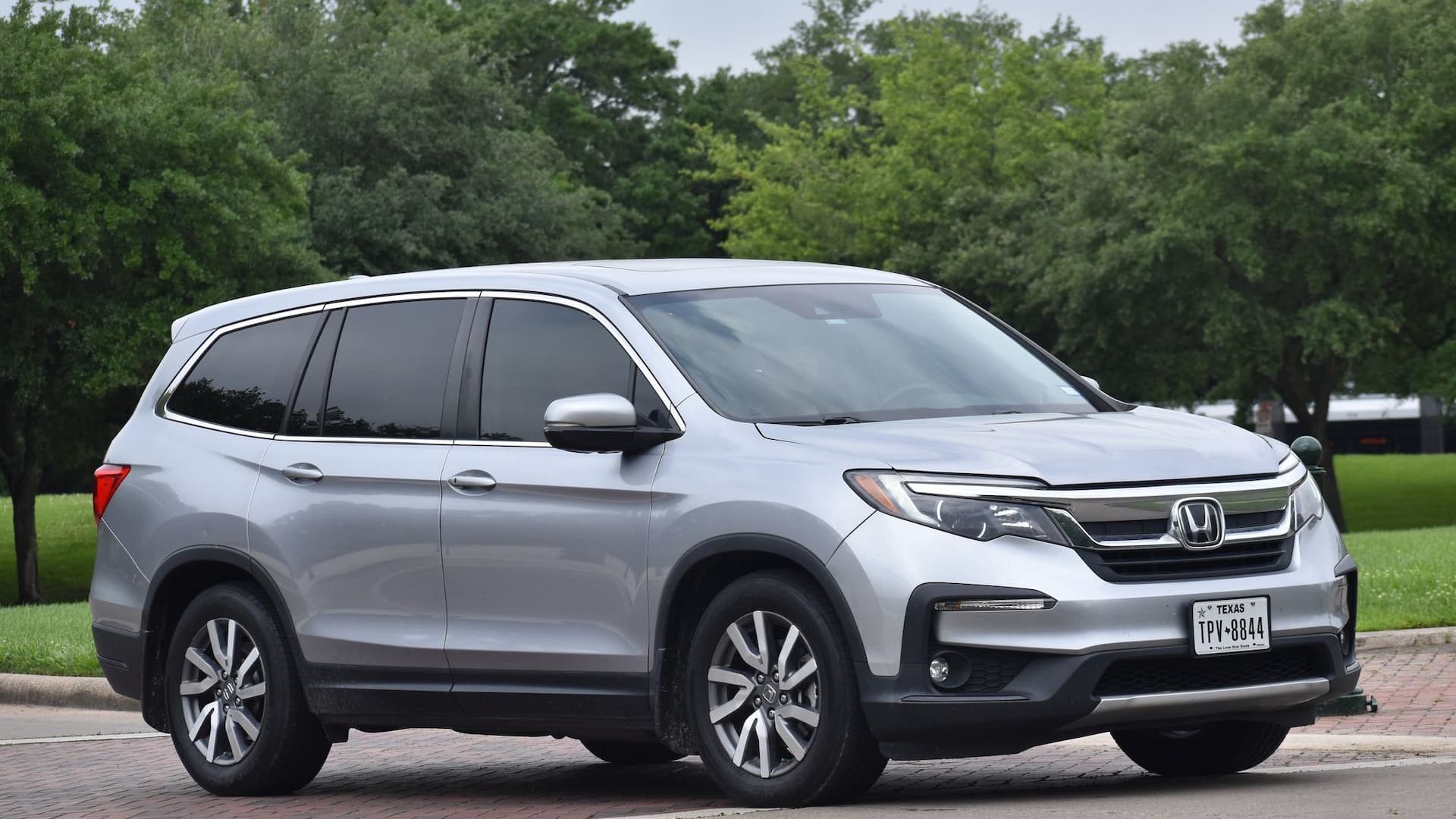
Known as a dependable vehicle, the Honda Pilot stands out for its sturdy build and reliable performance. While most models hold up well with proper maintenance, a few earlier versions did experience transmission-related concerns.
Key reliability factors for Honda Pilot:
- Reliability ratings: The Honda Pilot has a strong J.D. Power reliability score (around 80–83/100) and is consistently ranked among the top mid-size SUVs.
- Performance and build quality: Recent models feature a refined V6 engine, a smooth ride, and a well-built, durable interior suited for family use — key advantages that highlight Honda Pilot pros.
- Known issues: Owners report transmission problems in some earlier models, while certain later models had minor infotainment and electrical system troubles. Some models were also recalled to address issues, like the 2016 Honda Pilot recall.
- Maintenance: The Honda Pilot has slightly higher maintenance costs than other vehicles in its segment.
Top model years:
- 2008 Honda Pilot
- 2012 Honda Pilot
- 2015 Honda Pilot
- 2018 Honda Pilot
- 2022 Honda Pilot
Best trim to consider:
- Honda Pilot Elite
- Honda Pilot TrailSport
Best used cars to consider:
- 2010 Honda Pilot
- 2014 Honda Pilot
- 2015 Honda Pilot
Thinking about buying a Honda Pilot, but don’t know how dependable it is?
We’ll cover its reliability ratings, ownership costs, key issues, and the most reliable vehicle models so that you don’t need to research more models.
This Article Contains:
- Honda Pilot Reliability Overview
- Average Annual Cost of Maintaining a Honda Pilot
- 6 Common Issues Affecting Honda Pilot Reliability
- Most Reliable Honda Pilot Models & Trims Worth Owning
- Tips to Improve the Reliability of Your Honda Pilot
- Honda Pilot Warranty & Coverage: An Overview
Honda Pilot Reliability Overview
Reliability survey results give a clear picture of how the Honda Pilot compares with other mid-size SUVs, be it long-term dependability or ownership experience.
Let’s take a closer look at Honda Pilot reliability ratings:
1. J. D. Power
In the J.D. Power 2026 Vehicle Dependability Study, the Honda Pilot received an overall reliability score of 83 out of 100. It was also ranked second among mid-size pickups.
Here’s how it fared in other areas of reliability:
- Quality and dependability: 81/100
- Driving experience: 82/100
- Resale: 87/100
- Dealership experience: 83/100
2. Edmunds
Edmunds gave the Honda Pilot an overall reliability rating of 6.4 out of 10 in 2026, ranking it ninth among 17 mid-size SUVs.
Understanding what it really costs to own a new car like the Honda Pilot starts with a closer look at real-world maintenance and ownership expenses.
Average Annual Cost of Maintaining a Honda Pilot
The Honda Pilot has an average annual maintenance cost of around $540.
This is higher than the annual maintenance costs of other vehicle models, like the Acura RDX at $500 and the Honda CR-V at $410. However, actual expenses depend on factors like vehicle age, mileage, location, and service provider.
The likelihood of the vehicle requiring a major repair is around 13%, which is in line with mid-size SUVs and slightly higher than the overall average of 12%.
Data also shows that owners average about 0.5 unscheduled repair visits per year, slightly higher than the roughly 0.4 visits per year seen for mid-size SUVs and across all Honda vehicles.
Wondering what leads to these repair costs?
Let’s take a look at a couple of problems that could affect your vehicle longevity.
6 Common Issues Affecting Honda Pilot Reliability
From Bluetooth issues to brake problems, here are a few potential problems Honda Pilot owners may face:
- Transmission failure: Certain model years, such as the 2016 Honda Pilot, have been reported to have transmission issues, like gear slipping and jerky shifting. This can impact performance and may require prompt attention.
- Engine and oil consumption issues: Some model years experience excessive oil consumption or minor engine faults, like timing belt issues and faulty sensors. This can lead to overheating, engine damage, or reduced fuel economy if ignored.
- Electrical and infotainment system faults: Honda Pilot owners have reported issues with wiring, sensors, and infotainment systems. This can affect features such as cameras, displays, and connectivity functions like Bluetooth, Android Auto, and Apple CarPlay.
- Brake and suspension wear: Premature brake wear, warped rotors, and suspension problems can cause vibrations and reduce driving comfort.
- Fuel system issues: Some models have reported fuel pump or injector faults, as well as occasional leaks, which can affect performance. For instance, the 2016 Honda Pilot recalls occurred because the model had a leaking fuel tank, increasing the risk of fuel leakage and fire.
- Paint, trim, and minor build issues: Problems such as peeling paint, loose trim, and interior quality concerns are also noted in certain model years, such as the 2019 Honda Pilot.
Despite some occasional issues, many Honda Pilot models are well known for their durability and can last for years with proper maintenance.
Most Reliable Honda Pilot Models & Trims Worth Owning
Here are some of the most reliable vehicle years:
- 2008 Honda Pilot: This reliable SUV features a proven drivetrain and minimal electronics. It’s ideal for buyers seeking long-term durability and light off-road use on a budget, with both all-wheel drive and front-wheel drive configurations available.
- 2012 Honda Pilot: A well-refined model with improved reliability and fewer mechanical issues. This second-generation SUV offers a solid balance of comfort, space, and dependability.
- 2015 Honda Pilot: A well-rounded mid-size SUV with a strong V6 engine and spacious three-row seating, making it practical for families. It’s also the most reliable year of its generation, making it a top choice for worry-free ownership and consistent performance.
- 2018 Honda Pilot: A more modern SUV with updated tech and improved reliability over earlier 3rd-gen models. It’s great for those who want newer features without major compromises, with options for all-wheel and front-wheel drive.
- 2022 Honda Pilot: The third-generation model benefits from years of refinement and strong reliability ratings. It’s ideal for buyers seeking modern design, comfort, and confidence for everyday use and occasional off-road driving.
Best trims to consider:
- Honda Pilot Elite: It’s the top-tier trim of this mid-size SUV, offering advanced tech and a powerful V6 engine. It also offers all-wheel drive (AWD), high-end interiors, and modern features, such as the Honda Sensing suite (a package of advanced safety features including adaptive cruise control and lane-keeping assist).
- Honda Pilot TrailSport: This trim adds enhanced off-road performance, tougher styling, and adventure-ready features, such as standard all-wheel drive with trail-driving modes.
Best used cars to consider:
- 2010 Honda Pilot: A good balance of reliability and features, with improved build quality over first-gen models.
- 2014 Honda Pilot: One of the most dependable pre-2015 models, with strong reliability and minimal complaints.
- 2015 Honda Pilot: Most refined version of its generation, with improved fit and finish, better feature integration, and a reliable overall package.
Buying the right Honda Pilot is just the first step. Whether you get a used or new car, retaining its long-term value depends on following a few essential maintenance practices.
Tips to Improve the Reliability of Your Honda Pilot
Here are some smart habits to keep costly repairs at bay:
- Follow routine service schedules, such as timely oil changes, filter replacements, and system inspections. This keeps the engine operating efficiently and reduces long-term wear.
- Top up engine oil, coolant, transmission fluid, and brake fluid regularly. It’ll prevent overheating, friction damage, and premature component failure.
- Don’t ignore dashboard alerts like the check engine light. Early diagnosis can prevent a minor issue from escalating into major repairs and compromising highway safety.
- Inspect the radiator, hoses, and coolant condition periodically to ensure proper temperature regulation.
- Check shocks, bushings, and steering parts to maintain ride comfort, handle stability, and highway safety.
- Address small concerns, such as leaks, unusual noises, or vibrations, promptly to avoid more extensive and costly repairs down the line.
Performance aside, the Pilot is backed by Honda’s warranty coverage — reassuring you every time you’re on the road.
Honda Pilot Warranty & Coverage: An Overview
Whether it’s a second-generation or third-generation Honda Pilot, every new car comes with a few ownership benefits:
- Honda Care plans: Vehicles under 3 years old with fewer than 36,000 miles may qualify for the Honda Care Vehicle Service Contract, which extends warranty coverage. Those with less than a year and 12,000 miles are eligible for Honda Care Maintenance, which covers routine services and reduces early ownership costs.
- Standard Honda Limited Warranty: All new Honda vehicles include a 3-year/36,000-mile limited warranty and a 5-year/60,000-mile powertrain warranty. This covers key components like the engine. Warranty terms may vary for EV models, so it’s best to check model-specific details.
- Honda Service Pass: This provides complimentary maintenance for the first 12 months or 12,000 miles, whichever comes first. This program includes essential services such as oil changes, tire rotations, and multi-point inspections.
- Accessory and parts coverage: Add-ons and replacement components installed at the time of purchase are covered by a 3-year/36,000-mile warranty. Replacement parts come with a 1-year warranty (including labor when installed by a dealership). Meanwhile, remanufactured parts are backed by a 3-year/36,000-mile nationwide warranty. This ensures the proper functioning of components and safety features, like adaptive cruise control and the Honda Sensing suite.
- Roadside assistance: Honda offers 24-hour roadside assistance for 3 years or 36,000 miles for model-year 2015 onwards. This service includes emergency support, such as jump-starts, flat tire assistance, and towing.
- Additional coverage: Honda also offers a 5-year unlimited-mile corrosion warranty, protecting against rust perforation and helping preserve the vehicle’s structure and appearance over time.
NOTE: Warranty coverage is valid only for vehicles operated within the contiguous United States, Alaska, and Hawaii. Vehicles used outside these regions, including U.S. territories such as Puerto Rico, are not eligible for warranty coverage.
Get Easy Honda Pilot Care with AutoNation Mobile Service
Regular maintenance is essential to preserving your Honda Pilot’s reliability, performance, and long-term value. Addressing a minor issue early helps ensure safety, avoid costly repairs, and keep your SUV running smoothly.
With AutoNation Mobile Service, expert technicians come directly to your driveway to perform convenient services like oil changes and tire rotations. You’ll also benefit from transparent upfront pricing, easy online scheduling, and a 12-month, 12,000-mile warranty on all services for added peace of mind.
Schedule your service today and keep your Honda Pilot running at its best.