
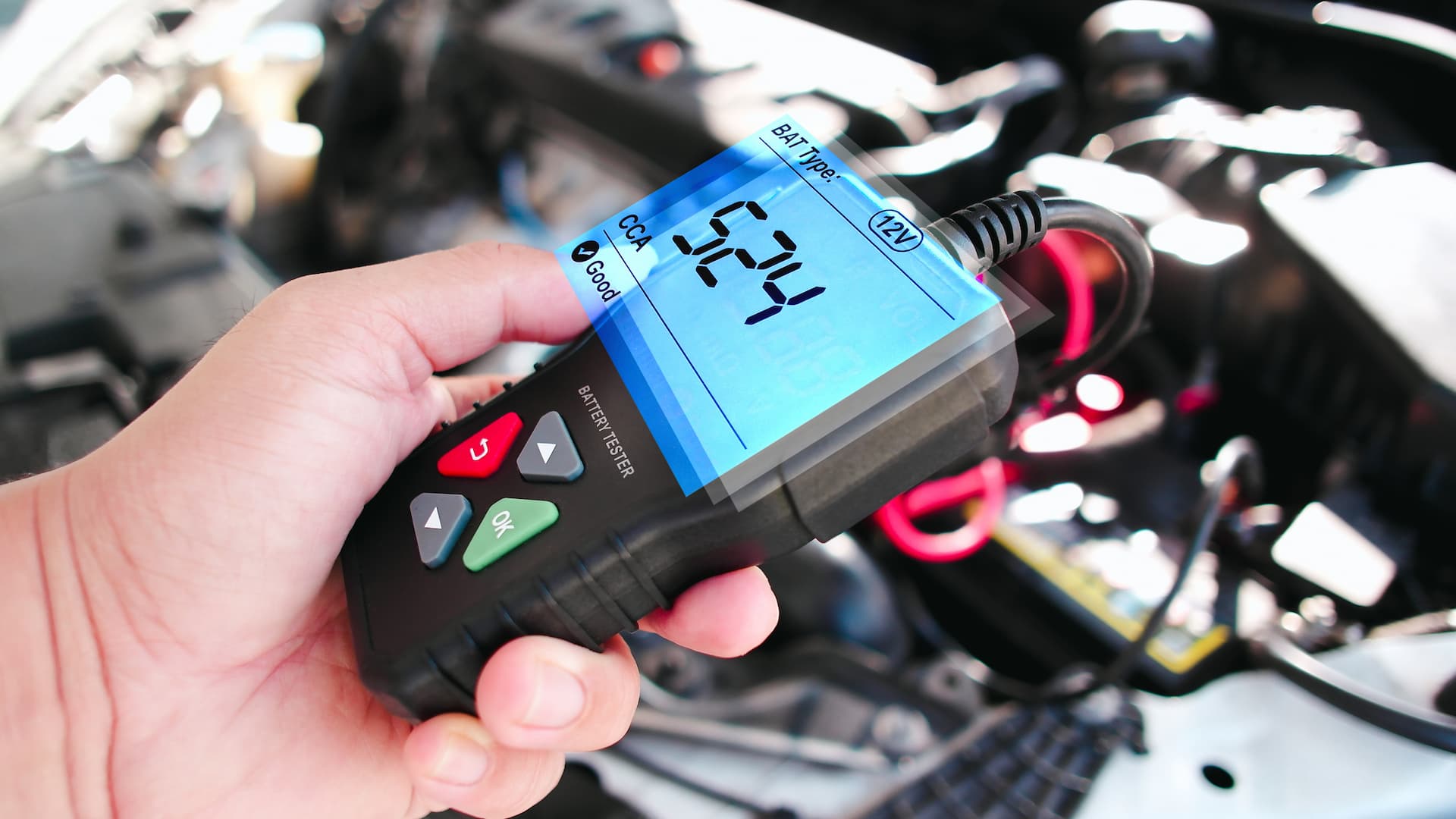
For most V6 engines, 600 to 850 cold cranking amps (CCA) is the sweet spot for reliable cold starts.
While some V6 vehicles may start with as little as 500 CCA, that leaves little margin for cold weather, battery aging, or added electrical demand — often leading to slow cranks or no-start issues.
We’ll break down the recommended CCA range for V6 engines, how to choose the right rating for your vehicle, and why V6 engines need more cranking power than smaller engines.
This Article Contains:
- The Recommended CCA Range for V6 Engines
- 5 Steps to Determine the Correct CCA for Your Specific V6 Vehicle
- Why V6 Engines Need More Cold Cranking Amps Than Smaller Engines
- Why Voltage Stability Matters as Much as CCA?
The Recommended CCA Range for V6 Engines
A battery rated between 600 and 850 CCA gives most V6 vehicles enough starting power with a healthy safety margin. Dip below this range, and the margin disappears. Slow cranking becomes more likely, especially on cold mornings.
However, this broad range exists because not all V6 engines are built or used in the same way.
Common V6 Engine Sizes and Their Ideal CCA
V6 engines come in several sizes, typically ranging from 2.5L to about 4.0L. Where your engine falls in that range, and what type of vehicle it’s installed in, plays a big role in how much CCA you actually need.
Heavier vehicles, larger engines, and bigger starter motors all place more demand on the battery, pushing CCA needs higher.
Here’s how typical V6 engine sizes and vehicle types translate into real-world CCA needs:
- V6 Sedans and Crossovers: 600–650 CCA
- Typically use 2.5L–3.5L V6 engines with lighter drivetrains
- Smaller starter motors place less demand on the battery
- 600–650 CCA is usually sufficient when the battery is in good condition
- Common examples include Honda Accord V6, Toyota Camry V6, and Nissan Maxima
- In mild climates, vehicles in this category often start reliably at the lower end of the range
- V6 SUVs and Trucks: 700–850 CCA
- Larger displacement engines (3.5L–4.0L+) require more force to turn over
- Heavy-duty starter motors draw significantly more current from the battery
- Higher electrical demands from towing packages, off-road lights, and winches
- 750 CCA is the standard benchmark for reliable year-round performance
- Common examples include Ford F-150, Toyota Tacoma, and Chevrolet Silverado
- In extreme cold or work conditions, 800+ CCA is recommended to ensure a margin of safety
Want to find the exact CCA for your vehicle? We’ve got you covered.
5 Steps to Determine the Correct CCA for Your Specific V6 Vehicle
Follow these five steps to ensure your V6 starts every time, regardless of the weather:
Step 1: Find the Manufacturer’s Recommended CCA Rating
- Consult your owner’s manual for the exact factory battery rating.
- Inspect the original battery label or the OEM part number.
- Search dealer catalogs using your VIN for the precise CCA value.
- Treat this number as a minimum; never install a battery rated lower than this.
Step 2: Use Engine Displacement Only to Sanity-Check the OEM Rating
- Apply the general rule of 1 CCA per cubic inch of engine size.
- Convert your engine size from liters to cubic inches. For example, a 3.5L V6 is roughly equivalent to 215 cubic inches.
- This number represents a bare minimum needed to turn the engine over, not a real-world requirement.
- In practice, multiply this base number by 2–3X to account for cold oil, internal friction, and starter load. Using the above example: 215 * 3 = 645 CCA.
- If this calculated number roughly matches the OEM recommendation or your target range, you’re in the right ballpark. In case it doesn’t, recheck the OEM spec rather than relying on this rule alone.
Step 3: Adjust the CCA Based on Climate Conditions
- Stay close to the OEM rating in warm or mild climates.
- Add 50–100 CCA in areas with regular winter temperatures.
- Choose the upper end of the V6 range in regions with severe or prolonged cold.
Step 4: Account for Vehicle Usage and Electrical Load
- Add extra CCA if most trips are short and the battery rarely fully recharges.
- Choose a higher CCA if the vehicle uses power-hungry features like remote start or heated seats.
- Older engines and starter motors often need more cranking power to turn over.
- Keep in mind that aftermarket electronics increase parasitic draw and reduce available starting power.
Step 5: Confirm Battery Size, Fitment, and Compatibility
- Match the correct battery group size to the vehicle’s tray.
- Verify terminal orientation so the cables reach without strain.
- Secure the hold-down bracket to prevent movement and vibration damage.
- A higher CCA rating only helps if the battery fits and mounts properly.
Learn more about cold cranking amps, why they matter, and how to choose the right rating for your vehicle in our detailed guide — What is Cold Cranking Amps?
Once you’ve chosen the correct CCA on paper, it helps to understand why V6 engines ask more from a battery in the first place.
Why V6 Engines Need More Cold Cranking Amps Than Smaller Engines
V6 engines have greater internal mass and higher compression than 4-cylinder engines, which creates more resistance during startup. With six cylinders to turn instead of four, the starter motor needs more torque and draws more power from the battery.
Additionally, in cold weather, thicker engine oil creates extra resistance just as the battery produces less power, forcing it to work harder during startup.
Why Voltage Stability Matters as Much as CCA?
Cold cranking amps determine how much power a battery can deliver during startup, but how stable that power is matters just as much.
Modern vehicles rely on multiple electronic control units (ECUs) that must receive steady voltage while the engine is cranking. When a battery is weak or undersized, voltage can drop sharply during startup. Even if the engine turns over, that voltage sag can prevent the vehicle from starting properly.
Choosing a battery with a higher CCA rating helps minimize voltage drop, ensuring that the starter motor and onboard electronics receive sufficient power simultaneously. This is especially important in cold weather, where batteries naturally produce less voltage, and engines require more effort to turn.
In short, higher CCA doesn’t just help your engine crank—it helps your vehicle’s electronics stay online during startup.
Choose the Right Battery, Let AutoNation Mobile Service Handle the Rest
Choosing a battery with adequate cold cranking amps ensures reliable starts, stronger electrical performance, and fewer cold-weather surprises.
But battery readiness isn’t just about specs on paper.
AutoNation Mobile Service helps you select, test, and replace the right battery for your vehicle—right at your location, seven days a week. Book online for transparent pricing, expert service, and peace of mind backed by our 12-month | 12,000-mile warranty.
Schedule your battery service before cold weather puts your starting power to the test.