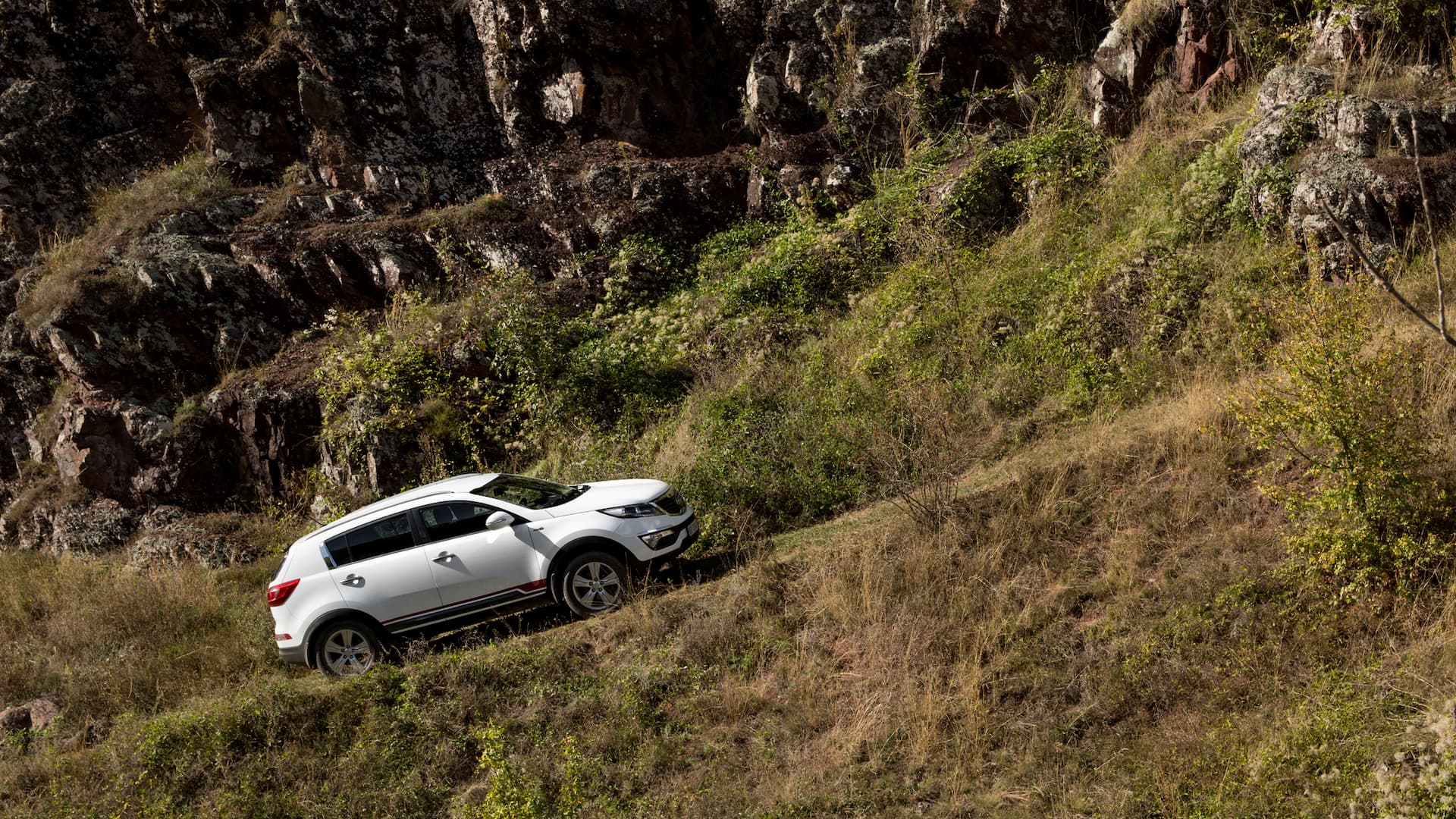
You’re driving through the hills and decide to pull over on a slope to take in the view. As you get ready to move again, the hill start assist warning light flashes on the dashboard.
You hit the throttle, but the car barely responds — the engine strains, the wheels slip, and moments later, the brake light also shows up.
It’s obvious to feel alarmed and confused when such unexpected warnings pop up, especially on an incline.
In this article, we’ll break down what the hill start assist warning light means, what causes it, and steps to resolve it.
This Article Contains:
- What Is the Hill Start Assist Warning Light?
- How Does the Hill Assist Control Work?
- What Triggers the Hill Start Assist Warning Light?
- Is It Safe to Drive with the Hill Assist Warning Light On?
- How to Fix a Hill Assist Warning Light Issue
What Is the Hill Start Assist Warning Light?
The hill assist warning light is a dashboard indicator that tells you something is wrong with the hill start assist feature. This feature briefly holds the brakes on an incline, preventing the car from rolling backward and helping it move forward — without using the parking brake.
NOTE: If the light flashes momentarily, it’s likely just active while the feature engages on a slope — this is normal. But if this light turns on and stays on, it indicates an issue.
It typically appears as a symbol of a car on a slope, along with messages like:
- “Check hill start assist”
- “Hill start assist not available”
- “Hill start assist problem”
The hill assist light may also turn on due to underlying issues with other systems, such as the engine and transmission, that disable the hill assist as a safety precaution.
NOTE: The hill start assist feature differs from the hill descent control. Hill assist stops your car from rolling backward uphill, while hill descent control automatically controls your speed when going downhill.
Now that you understand what the light means, let’s understand how the hill assist feature functions.
How Does the Hill Assist Control Work?
Here are the basic steps of how a hill assist system works:
- Detects a slope: The system uses sensors, like an accelerometer or wheel speed sensor, to detect when the car is on an incline.
- Engages the brakes: When you come to a full stop on a slope, hill assist holds the brake pressure even after you take your foot off the brake pedal.
The system is slightly different for a manual and an automatic transmission:
- For a manual transmission, the system typically activates when you press both the brake and clutch pedals while on a slope.
- In an automatic transmission, hill assist usually activates when you stop on an incline with your foot on the brake.
- For a manual transmission, the system typically activates when you press both the brake and clutch pedals while on a slope.
- Holds the vehicle: The system keeps the brakes engaged for about 2 to 3 seconds. This gives you time to move your foot from the brake to the throttle pedal without the car rolling backward or forward.
- Releases the brakes: As you press the accelerator and the engine power builds up, the system automatically releases the brakes, allowing for a smooth start on the slope.
NOTE: Hill start assist, adaptive cruise control, forward collision warning, electronic stability control, active stability control, or blind spot monitoring are all driver assistance systems.
Electronic stability control and hill start assist are often standard in most modern vehicles. But features like adaptive cruise control, forward collision warning, blind spot monitoring, and lane departure warning are usually found in expensive car models.
So what exactly activates the hill assist light?
Let’s unpack.
What Triggers the Hill Start Assist Warning Light?
The hill assist warning light can show up due to several reasons, including:
1. Incline Sensor Failure
If the incline sensor malfunctions or gives incorrect readings, hill assist may either activate unnecessarily or fail to engage. This triggers the hill assist and check engine lights.
2. Clutch Position Sensor Fault
When this sensor fails or becomes misaligned (in a manual transmission), hill assist may fail to hold the vehicle. This can cause the check engine, clutch warning lights, and the hill assist light to appear together.
3. Brake Pressure Misread
Low brake fluid, air in the brake lines, or a faulty pressure sensor can alert the engine control unit (ECU) to a brake issue. The ECU will then disable hill assist and turn on the warning light, along with the brake light.
4. Delayed or Failed Brake Release
Hill assist relies on brake actuators to apply and release brake pressure smoothly. If the brake actuators malfunction, they may hold the brakes too long or release them unevenly. This can cause the hill assist and brake warning light to appear.
5. Calibration Errors
For some car models, the hill assist system may need recalibration after a battery replacement or software update. If this recalibration isn’t complete, the feature might not engage properly, triggering a warning light with the ABS light.
6. ABS or Traction Control Issues
Hill assist relies on components from the anti-lock braking system (ABS) and traction control system, like the wheel speed sensor. If these components are faulty, the traction control light, hill assist warning, and ABS light may appear together.
7. Engine or Transmission Problems
If the engine develops a serious fault, such as a misfire, the ECU may disable the hill assist feature for safety.
Transmission issues, like extremely low transmission fluid, can cause the vehicle to enter limp mode as a standard procedure. This restricts power and automatically disables vehicle features, including the hill assist, to protect the drivetrain.
In these situations, you may notice an illuminated check engine light, transmission warning light, limp mode indicator, and hill assist light.
8. Battery Issues
A low battery can impact multiple car systems. This can range from hill assist to electronic features like the map light, fog lights, remote engine start, and electric power steering.
9. Software or ECU Issues
Hill assist relies on precise coordination between sensors, braking systems, and the vehicle’s ECU. But the system may malfunction if there is an incomplete system update or a communication error between control modules. This can trigger the hill assist warning light and the check engine light.
Now, here’s a big question you’re probably wondering about:
Is It Safe to Drive with the Hill Assist Warning Light On?
If the hill assist warning light appears on your dashboard, you can typically keep driving on flat roads. However, under driving conditions involving slopes, you’ll need to hold the main brake or use your parking brake manually, since the hill start assist won’t engage.
When the hill assist light activates alongside the ABS light or traction control light, it may indicate a broader issue affecting critical vehicle safety systems.
In this case, it’s best to seek professional help ASAP to restore stability and driving comfort.
Wondering about the process of repair?
Let’s walk you through it.
How to Fix a Hill Assist Warning Light Issue
When a hill assist warning light appears, a technician will follow a step-by-step process to diagnose and fix the problem. They’ll:
- Run a diagnostic scan to check sensors like the incline sensor or wheel speed sensors. If any are malfunctioning, they’ll replace the faulty sensor.
- Test the car battery’s health and charge. They’ll replace the battery and ensure it’s properly installed.
- Recalibrate, repair, or replace the traction control or electronic stability control (ESC) systems to restore proper function.
- Check the transmission system for faults, such as shift delays or faulty transmission speed sensors that may interfere with hill assist activation.
- Check if the anti-lock braking system is causing the warning (using a diagnostic test) to determine whether it needs repair or replacement.
- Inspect the braking system — including pads, rotors, and fluid levels — to ensure everything is in good condition. They’ll replace any faulty components as needed.
- Check for and install any available software updates or patches (targeted updates). If the issue persists after updating, they may reprogram or replace the control module.
- Turn the car off and on again to clear temporary errors and reset the system.
- Test drive the vehicle on an incline to ensure the system functions correctly. They may even perform a second test drive under varied driving conditions, like stop-and-go traffic or uneven surfaces, to ensure the warning doesn’t return.
Resolve Hill Start Assist Issues Quickly with AutoNation Mobile Service
A hill assist fault might initially seem like a minor inconvenience, but it can be a sign of deeper issues with your engine or transmission. It often appears suddenly, compromising your safety on the road.
Don’t let a warning light derail your day.
With AutoNation Mobile Service, experienced mechanics come straight to your location to diagnose and repair the issue. We’re available seven days a week, offer transparent pricing, and back every repair with a 12-month, 12,000-mile warranty.
Get in touch today to restore your vehicle’s safety and comfort.