
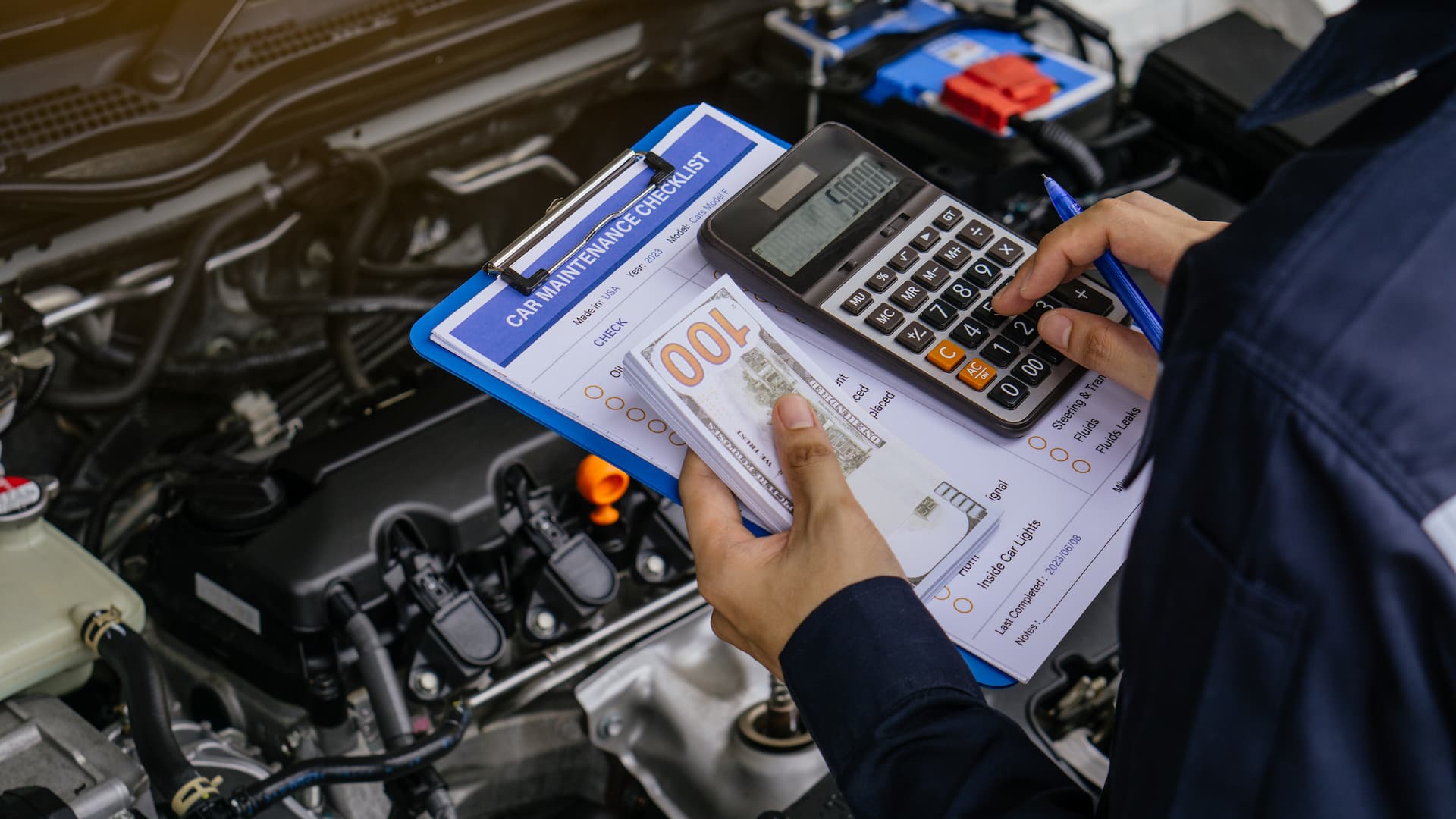
You take your car in for a repair and get an estimate filled with parts, labor hours, fees, and a final total.
But where do all those costs come from?
A car repair estimate isn’t simply the price of a replacement part plus the time it takes to install it. Depending on the repair, the total may include:
- Labor
- Parts and parts markup
- Diagnostic work
- Shop supplies and other fees
- Taxes
Understanding these charges can help you know what you’re paying for before you approve a repair.
What Goes Into a Car Repair Estimate?
Although estimates can look different from one repair shop to another, you’ll typically see some combination of these costs:
| Estimate Item | What You’re Paying For |
| Labor | Technician time and expertise |
| Parts | Costs associated with sourcing, supplying, and supporting the parts |
| Diagnostic fee | Time and equipment used to identify the problem |
| Shop fees or supplies | Consumable materials and other shop-related costs |
| Taxes | Applicable state and local taxes |
Some estimates itemize these costs individually, while others may bundle certain charges together.
Let’s look at the major costs in more detail.
How Labor Charges Work
Labor charges generally depend on two things: the shop’s labor rate and the number of labor hours assigned to the repair. For example, if the labor rate is $150 per hour and the repair requires 2 hours of labor, the labor charge would be $300.
However, those 2 hours don’t necessarily mean a technician will spend exactly two hours working on your car.
Many repairs use standardized labor guides that specify how long a particular job should take. This is sometimes called flat-rate or book-time labor. A job assigned 2.5 hours may therefore be billed at 2.5 hours even if an experienced technician finishes sooner.
Labor rates can also vary depending on location, shop type, technician expertise, equipment requirements, and business overhead.
So, when looking at an estimate, consider both the hourly rate and the number of labor hours.
Why Parts Cost More Than the Store Price
You might search for a replacement part online and find it for $200, then notice that your repair estimate lists the same type of component for $300.
That difference may be partly due to parts markup.
Repair businesses generally purchase parts and resell them to customers at a higher price. The markup helps cover the costs and risks associated with supplying the part and contributes to the repair business’s operating margin.
Depending on the business, it can help account for:
- Finding and ordering the correct part
- Shipping and inventory handling
- Dealing with incorrect or defective components
- Warranty administration
- Business operating costs
- Responsibility for the supplied part
There’s no single markup percentage that applies to every repair shop or every component.
The type of replacement part can affect the price, too.
Common options include:
- OEM parts: Made by or for the vehicle manufacturer. These may cost more than comparable alternatives.
- Aftermarket parts: Produced by third-party manufacturers. Price and quality can vary considerably.
- Remanufactured or rebuilt parts: Previously used components that have been disassembled, inspected, restored as needed, and reassembled for reuse.
That’s why comparing the parts price on an estimate with the cheapest listing you can find online isn’t always an apples-to-apples comparison.
What About Diagnostic Fees and Shop Charges?
Not every charge on an estimate is directly tied to replacing a component.
A diagnostic fee covers the work involved in figuring out what’s wrong with the vehicle. Depending on the problem, diagnosis may require inspections, testing equipment, scan tools, and technician time.
That work still has value even if you decide not to proceed with the recommended repair.
You may also see charges for shop supplies or fees. These can cover consumable items used during the job, such as cleaners, lubricants, rags, or small hardware. Some repairs may also involve disposal or similar charges.
Exactly how these costs appear on an estimate varies by repair provider.
5 Things to Check Before Approving an Estimate
You don’t need to understand every technical detail of a repair to make sense of an estimate. Start by checking these five things:
- Is the estimate itemized?
You should be able to see what you’re paying for and what work is being recommended.
- What are the labor rate and labor hours?
Look at both numbers rather than focusing on the hourly rate alone.
- What type of parts will be used?
Find out whether the estimate includes OEM, aftermarket, remanufactured, or other replacement parts.
- What warranty comes with the repair?
Check whether the warranty covers the parts, labor, or both.
- Could the price change after work begins?
Ask what happens if additional problems are discovered and whether you’ll be contacted before extra work is performed.
And remember: the cheapest estimate isn’t necessarily the best one.
A good repair estimate should clearly show what work is being recommended, what parts are being supplied, and what you’re expected to pay.
Get a Clear Estimate Before Your Repair
AutoNation Mobile Service provides an upfront estimate before booking, so you can review the expected repair and cost before a mobile technician arrives.
Our mobile technicians can perform many diagnostic, maintenance, and repair services right in your driveway. Qualifying repairs are also backed by a 12-month/12,000-mile parts-and-labor warranty.