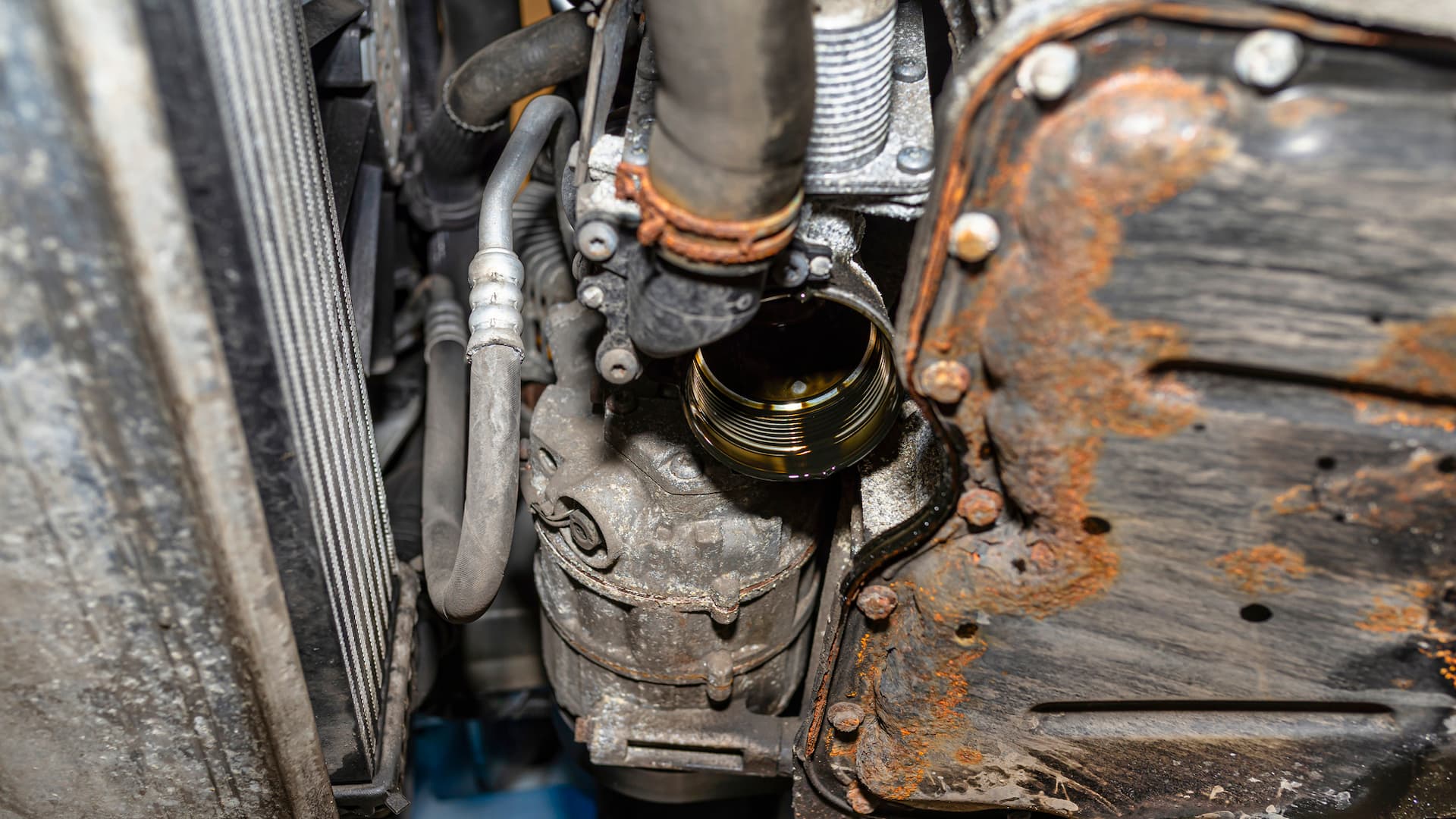
A stuck oil filter (usually a spin-on filter) is a seriously frustrating and often messy problem.
But it’s not uncommon, so don’t give up yet!
We’ll show you five ingenious methods you may not have tried, plus a few pro-tips to loosen things up. You’ll also learn how to replace the filter in a way that prevents the problem next time, and what to do next if all your efforts are unsuccessful.
Let’s turn it up!
This Article Contains:
- 5 Clever Ways to Remove a Stuck Oil Filter
- 4 More Do’s and Don’ts When Removing a Stuck Filter
- How to Install an Oil Filter to Prevent It from Getting Stuck
- Recap: How to Perform an Oil Change from Start to Finish
- What to Do if You Can’t Remove an Oil Filter
- How Much Does It Cost to Replace a Broken Oil Filter?
5 Clever Ways to Remove a Stuck Oil Filter
These five methods are listed in the order you should try them — from standard fixes to the last-resort options.
Why this order?
The more you damage the spin-on oil filter, the harder it is to remove. So, start with tools made for the job (for example, a cap wrench or oil filter wrench). If a tool crushes the filter instead of turning it, that’s a sign to try something else.
IMPORTANT: Your car can’t run without an oil filter. If you’re worried about removing it or don’t have the right tools, contact a mechanic before the problem gets dire.
Now, let’s get started with the first method.
1. Oil Filter Cap Wrench
An oil filter cap wrench is like a big socket that fits on the bottom of your oil filter. They come in various sizes to fit different filters, or you can get an adjustable one that fits any oil filter.
Fit it to the bottom of your oil filter, attach a socket wrench, and give it a solid turn.
2. Other Gripping Tools
If a cap wrench doesn’t work, try some other gripping products to get torque on the filter.
CAUTION: The second the filter starts crumpling from pressure without turning, you should stop and reposition or switch tools.
Here are some tool options:
- Tongue and groove (or water pump) pliers: Open to grip the oil filter, place it on, put pressure on the handles, and turn.
- Oil filter wrench (or pliers): Clamp on the filter wrench, hold both handles tightly, and turn.
- Swivel gripper: Loop over the filter, tighten by swiveling the handle, and turn.
- Strap wrench: Loop around the filter, tighten the band, and turn. A rubber or chain strap wrench can offer extra grip.
- DIY Tourniquete: If you don’t want to splash out on buying gripping products, you can DIY one. Tie a length of rope in a circle and flatten it. Feed one end through the other like a dog’s slip leash. Put one prong of a spanner through the pulling loop and wrap some rope around the spanner’s shaft. Put the other loop over your oil filter. Twist the spanner to tighten the loop. Once tight, turn the filter.
3. Hammer and Screwdriver
Still on there? Try this method only if gripping tools haven’t helped.
WARNING: This can get messy and may rip the sides of the oil filter, making it harder to grip with tools.
Hammer a thick screwdriver to pierce through both walls of the filter. Push counterclockwise on the handle to turn the filter.
4. Hammer and Chisel
If none of the above did the trick and your filter is mangled, the next step is to remove all the filter components besides the base piece that’s stuck on the filter housing.
You’ll see holes around the threaded center. Place a chisel against one hole at an angle and tap it counterclockwise with a hammer to loosen the base.
5. DIY Pronged Socket
This DIY method requires access to cut-off wheels and some time and effort.
With only the base piece of the filter left, use putty to make an impression of its hole pattern. Find a socket that lines up with the holes, mark their positions, and cut prongs into the socket.
Now you can slot the pronged socket into the oil filter holes, attach a socket wrench, and twist.
Tools aside, we have a couple more tips and tricks to help you get the job done.
4 More Do’s and Don’ts When Removing a Stuck Filter
These three simple tricks can help with stuck filter trouble regardless of what tools you’re using:
- Do: Turn counterclockwise (it’s an easy mistake to make.)
- Do: To strengthen the grip, try placing sandpaper (doubled over so the grit touches both surfaces) or latex between your tool and the oil filter.
- Do: Use a breaker bar with a compatible filter wrench to extend your reach when working in tight spaces around the engine compartment.
- Don’t: Use WD-40 to loosen the filter, as it can contaminate the system. However, penetrating oil may help.
Once you’ve removed your oil filter, it’s crucial to know how to install a new one without risking the same trouble at your next oil change.
How to Install an Oil Filter to Prevent It from Getting Stuck
Follow these five best practices to install filters securely, but not too tightly:
- Always remove the old gasket (the rubber ring around the filter base) from the filter housing and clean the surface afterwards.
- Put some oil on the gasket before putting the new filter on.
- Tighten the new filter by hand only. Never use gripping tools. Twist it on until it feels snug (hand tight) and give it an extra quarter-turn at most.
- Change the filter at every oil change — usually every 5,000 to 7,500 miles, but it depends on what kind of oil you use and what your car’s manufacturer recommends.
- Use quality filters from a reputable company — For example: FRAM, K&N, or Bosch.
Next, let’s get some more context for where the oil filter change fits into the overall oil change process.
Recap: How to Perform an Oil Change from Start to Finish
Here’s the full seven-step process to remove a spin-on filter:
- Run your engine for a while. The heat helps thin the oil out so it drains easily.
- Park on a level surface, engage the parking brake, and use jack stands to safely lift the car or truck if needed (especially to access the drain plug and filter in tight spaces within the engine compartment).
- Find the drain plug under the engine and position a drain pan to catch the oil.
- Remove the drain plug and let all the oil leak into the drain pan.
- Remove the old filter.
- Clean the filter mount and remove the gasket to avoid an oil leak, then screw on the new oil filter.
- Pour fresh oil into the engine. Start it for a second or two to circulate the oil. Confirm oil level with the dipstick.
Now, here’s the big question: What should you do if you’ve tried everything and still can’t get that stubborn filter off?
What to Do if You Can’t Remove an Oil Filter
If an oil filter removal goes wrong and you can’t replace the ruined old filter, you’re in a tough spot. Driving without an oil filter isn’t an option — it can cause catastrophic engine damage.
The best thing to do is to call a trusted mobile mechanic company.
Ideally, you’d have a mobile mechanic handle your oil change from the start. But even capable amateur car buffs can get stuck, and there’s no shame in calling reinforcements.
How Much Does It Cost to Replace a Broken Oil Filter?
If your oil filter was damaged during removal, it’s relatively inexpensive to replace. A new oil filter costs between $5 and $15.
But if you call a pro for a full oil change or to help with a stuck oil filter, here’s what to expect:
- Oil cost: $30 and $65, depending on whether it’s conventional or synthetic oil.
- Labor: $40 to $170
In total, the cost is between $75 and $250.
Unsure where to find a trustworthy mobile mechanic that offers fair prices and top-quality work?
Call AutoNation Mobile Service for Your Oil Filter Needs
Whether you’re stuck with a stubborn oil filter that feels welded on, or you want to err on the side of caution and avoid the hassle entirely — AutoNation Mobile Service is here for you.
You can have a qualified mobile mechanic come right to your driveway, so you don’t have to lift another tool. We offer fair, upfront pricing, convenient scheduling, and back every repair with a 12-month, 12,000-mile warranty.
Book your oil change or stuck filter fix today and let us take care of the rest.